

Readers of this blog will know that H. M. Pharma Consultancy has always been an adamant advocate of using patents not only as strategic tools but also as an invaluable source of technical and scientific information. In the engineering and information technology there would be no need to stress this, but in medicine and the life sciences the“ Patents-Ugh!” attitude remains strong.
Our little enterprise is certainly not the only one working towards a change of attitude here, but turning the tables is a slow process. Large segments of the bioscience community remain biased against intellectual property documents, to a good part because the legalistic and repetitive semantics of patents brushes scientists against the grain. Sometimes it is merely the unwillingness to search different databases, and using the different search methods which they require, that form an entry hurdle. There is also a frequently encountered opinion concerning information about new biomedical developments being published in peer review journals. In the simplest version this opinion has it that “everything worthwhile learning about will be published in journals anyway.”
Well, you can always argue what is or is not worthwhile reading, but H.M. Pharma Consultancy wanted to know the simple facts: In a given set of medical patents, how many have peer-reviewed companion papers? Are these published before or after the corresponding patent applications are published?
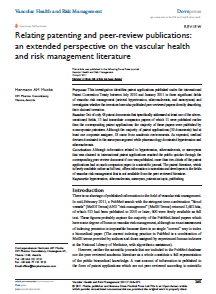
And here is the surprise: a search or the scientific literature shows that very few systematic investigations of this matter have been published that can claim any sort of scientific validity. General search engines return tons of opinion but hardly any facts. So I set out and did my own research, for three fields of cardiovascular medicine: atherosclerosis, hypertonia, and aneurysm. The result has just been published in Vascular Health and Risk Management. Its an Open Access paper which you can download here, and the high point is this: If an international patent application has a peer review companion, this paper is likely to reach the community earlier than the patent document; but only a minority of patents ever get a companion paper that you could find in PubMed.
In other words, ignoring patents will seriously impair the completeness of the information that you are using for your research.
Mucke HAM. Relating patenting and peer-review publications: an extended perspective on the vascular health and risk management literature. Vasc Health Risk Manag 2011:7 265–272
DOI 10.2147/VHRM.S14454 – PubMed entry forthcoming