

YES! — Did it again. Here are 9 international applications for life science patents, published in June 2011, that we find remarkable. Vision loss, cardiomyocyte regeneration, hepatic encephalopathy, and new targets for Alzheimer’s disease, influenza, and cancer are our subjects for this month. As always, we link chemical compounds to ChemSpider, genes and peer review literature to the respective NCBI resources, and patents to ESPACENET.
PLEASE CITE AS : Mucke HAM. Patent Highlights for June 2011. Published online on the H.M. Pharma Consultancy Blog (URL:http://hmpharmacon.blogspot.com/2011/07/patent-highlights-for-june-2011.html) on July 1, 2011. Contact us at office@hmpharmacon.com .
Three Novel Approaches to Ocular Diseases
Retinal vascular disorders (diabetic retinopathy and choroidal neovascularization as a complication of age-related macular degeneration) are the major causes for visual impairment in industrialized countries. Instead of photodynamic therapy or depletion of vascular endothelial growth factor, WO 2011/065968 (Scripps Research Institute [US]; June 3, 2011) proposes to use monocyte chemoattractant compounds, such as MCP-1 or fractalkine ( CX3CL1). The inventors demonstrated that new cells found in the retina after intravitreal chemokine injection were largely recruited from the circulation, and expressed the macrophage-microglia markers isolectin and CD11b, but not the lymphocyte markers CD3e or CD19. CX3CL1 or MIP-1 both resulted in significantly enhanced repair in a mouse model of ischemic retinopathy.
Glaucoma, also a significant reason for loss of eyesight, is commonly treated using eyedrops that reduce the increased intraocular pressure that accompanies most forms of the disease – but there are additional neurotoxic factors attacking the optic nerve head. WO 2011/075462 (Alcon Research [US]; June 23, 2011) modulates expression of the gene encoding serum amyloid A protein (SAA; a marker of inflammatory disease activity), or the interaction of SAA with its receptor. Most preferably, the agent will be fenofibrate, Wy-14643, (4-chloro-6-(2,3-xylidino)-2-pryrimidinylthiol)-acetic acid, ciprofibrate, 2-bromohexadecanoic acid, bezafibrate, ciglitizone, bafilomycin, concanamycin, or pseudolaric acid B.
Cataract and presbyopia are common age-related problems of the ocular lens that are not usually addressed pharmacologically; but the REDWING ocular module of our THIRDSPACE patent knowledgebase shows a constant trickle of such patent applications. The most recent example, WO 2011/075430 (University of Massachusetts [US]; June 23, 2011) is innovative: instead of the usual antioxidants or advanced glycation endproduct inhibitors it proposes electrostatic interaction inhibitors (simple salts or ionic solutions of organic compounds) to prevent the formation of betaL-crystallin aggregates as well as to deaggregate already formed aggregates. Effects on the kinetics of cyrstallin aggregation were extensively studied in vitro, in both water and PBS, but there are no data on intact lenses or animal data.
Differentiating Cardiac Stem Cells Into Cardiomyocytes
“A totally novel approach to stimulate in vivo resident cardiac stem cells and to commit them into the cardiac lineage” is claimed in WO 2011/067317 (Cardio3 Biosciences [BE]; June 9, 2011) . The approach consists of exposing the progenitor cells to cocktails of least two stem cells-stimulating-agents, preferably elected from the group consisting of TGF-1, BMP-4, FGF-2, IGF-1 , Activin-A (from the the TGF-β superfamily), Cardiotrophin 1 (a cardiac hypertrophic factor from the interleukin-6 cytokine family), and Merck’s Cardiogenol C which is 2-(4-methoxyanilino)-4-(1-hydroxyethylamino)pyrimidine. Microspheres or nanospheres are the preferred vehicles to be injected into the cardiac tissue. Experiments in a porcine model of acute myocardial infarction showed a pronounced reduction in infarct size. Immunostaining for c-kit was used to demonstrate that the regenerated myocardial structures originated from resident cardiac stem cells.
ARF6, A New Potential Target For Alzheimer’s Disease
ADP-ribosylation factor 6 ( ARF6) is a small GTPase that regulates the trafficking of endosomal membrane, and was not previously implicated in the pathogenesis of Alzheimer’s disease. In WO 2011/067420 (University of Leuwen [BE]; June 9, 2011) the inventors demonstrate that blocking beta-secretase (BACE1) in ARF6-positive cell vacuoles prevents processing of amyloid precursor protein (APP), significantly reducing the formation of beta-amyloid. BACE1 enter the cells via a clathrin-independent ARF6-mediated pathway before reaching the Rab5-positive endosome, whereas APP is internalized via a clathrin-dependent pathway. An imaging-based screening assay in mouse embryonic fibroblasts is described but apparently only as a prophetic example.
Peroxiredoxin-1 Is A TLR4 Ligand
WO 2011/071992 (Health Research [US]; June 16, 2011) is based on the discovery that peroxiredoxin 1 (coded by PRDX1) is a ligand for Toll-like receptor 4 ( TLR4), and that inhibition of its interaction with TLR4 (primarily by interfering antibodies and peptides) can be exploited for inhibition of tumor angiogenesis. Reduction of peroxiredoxin-1 levels by expression of interfering RNAs results in inhibition of prostate tumor growth in two murine tumor models of prostate cancer. As it seems this is purely through a loss of VEGF expression within the tumor microenvironment; tumor cell growth in vitro or cell survival in vivo were not modified. The ability of peroxiredoxin-1 to bind to TLR4 is dependent upon it chaperone activity. A huge amount of biological data is provided. This is the companion patent document to Cancer Res. 2011 ; 1;71(5):1637-46 (see here) which focuses on prostate cancer. Also see Health Research’s WO 2011/071988 of the same date claiming peroxiredoxin-1 as a vaccine adiuvant.
Macroporous Ferrogels As Drug and Cell Carriers
Ferrogels consist of magnetic micro- or nanoparticles that are confined in an elastic polymer network. Under a non-uniform magnetic field, particles will respond to the external force gradient and move to induce elongation, contraction, or bending of the gels with short response time. WO 2011/075516 (Harvard University [US]; June 23, 2011) exploits this to trigger the release of an active agent contained in the pores of the gel by altering porosity, pore size and connectivity, swelling agent concentration, and/or specific volume using an external magnetic field. The examples include the release of small molecules, plasmid DNA, and living cells. One hour after the implantation of ferrogels with enclosed murine mesenchymal stem cells into the back region of female nude mice, animals were exposed to 120 cycles of an external magnetic field by simply approaching and retracting a magnet against the skin of the mouse; fluorescent markers revealed burst release of stem cells into the surrounding tissue. A lot of literature exists on this “smart biomaterial” approach, – e.g., PNAS 2011;108(1):67-72, here and Phys Rev E Stat Nonlin Soft Matter Phys . 2009; 79(4 Pt 1): 040801, here – and patenting is competitive.
A New Approach To Influenza
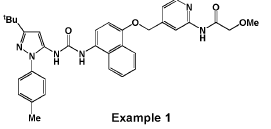
WO 2011/070369 (Respivert [GB]; June 30, 2011) claims a new target in influenza virus infection: HCK, a little-studied hemopoietic cell kinase from the Src B family that has been described as being involved in linking activation of the IgG-Fc receptor to the respiratory burst in neutrophils and macrophages ( Eur. J Cell Biol 2008; 87:527-42; here). In addition to many in vitro and in vivo data for this and related HCK inhibitors, the efficacy of N -(4-((4-(3-(3- tert -butyl-1-p-tolyl-1 H -pyrazol-5-yl)ureido)naphthalen-1-yloxy)methyl)pyridin-2-yl)-2-methoxyacetamide to inhibit influenza virus (H3N1 Memphis 71 strain) viral load in vivo in the mouse lung was investigated, and found to be reduced from 46.6 +/- 16.6 to 8.1 +/- 1.9 million pfu/g lung tissue. The HCK-related pathways would have be be investigated more closely before this could be developed into a drug, but the lead is exciting.
A Glutaminase Inhibitor For Hepatic Encephalopathy
Progressive liver failure will cause delirious conditions which are initially reversible, but ultimately hepatic coma will develop if neurotoxic compounds (in particular, ammonia) that are produced in the intestines are no longer effectively removed from the circulation before they reach the brain. (See the review in Expert Opin Pharmacother. 2010; 11(8):1317-27 by one of the inventors) . An intestinal enzyme, GAP ( glutaminase activated by phosphate) plays a central role by producing glutamate and ammonium. WO 2011/076967 (University of Sevilla et al. [ES]; June 30, 2011) claims N-phenyl-N’-(3-methyl-2-butenyl)thiourea as a suitable partial and non-competitive GAP inhibitor. This is a known compound ( CAS-RN: 104 741-27-7) and was described in Gazzetta Chimica Italiana 1960; 90:919-40. In rats with portocaval shunts, the cognitive impairment was improved in a Y-maze after doses that showed GAP inhibition in post-mortem isolated enterocytes and astrocyte mitochondria.
Progressive liver failure will cause delirious conditions which are initially reversible, but ultimately hepatic coma will develop if neurotoxic compounds (in particular, ammonia) that are produced in the intestines are no longer effectively removed from the circulation before they reach the brain. (See the review in Expert Opin Pharmacother. 2010; 11(8):1317-27 by one of the inventors) . An intestinal enzyme, GAP ( glutaminase activated by phosphate) plays a central role by producing glutamate and ammonium. WO 2011/076967 (University of Sevilla et al. [ES]; June 30, 2011) claims N-phenyl-N’-(3-methyl-2-butenyl)thiourea as a suitable partial and non-competitive GAP inhibitor. This is a known compound ( CAS-RN: 104 741-27-7) and was described in Gazzetta Chimica Italiana 1960; 90:919-40. In rats with portocaval shunts, the cognitive impairment was improved in a Y-maze after doses that showed GAP inhibition in post-mortem isolated enterocytes and astrocyte mitochondria.