

The International Patent Office has not been idle during this summer, and neither were we. Once again, ten international patent applications are brought to the fore: for childhood epilepsy, obesity, cancer, muscle wasting, Parkinson’s and Alzheimer’s disease, and for laser-triggered ocular drug delivery.
PLEASE CITE AS : Mucke HAM. Patent Highlights for August 2011. Published online on the H.M. Pharma Consultancy Blog (URL:http://hmpharmacon.blogspot.com/2011/08/patent-highlights-for-August-2011.html) on August 29, 2011. Contact us at office@hmpharmacon.com .
—
Genetic Diagnosis for Dravet Syndrome
Infants with a mutation in the SCN1A (neuronal sodium channel α1 subunit, Na v 1.1) gene can develop Dravet syndrome, a rare and difficult to control form of fever-triggered epilepsy during their first year of life that is sometimes misdiagnosed as vaccine encephalopathy (see here). This condition – a hereditary channelopathy – can later develop into a malignant myoclonal childhood epilepsy. Building on their discovery that altered Ca v 2.1 calcium channel function is another component of the condition (see here), Japanese researchers now claim a gene diagnostic method for the high-precision assessment of the potential for the development of Dravet syndrome based on these two channel α1 subunit mutations in WO2011/093393 (Okayama Univ. [JP]; Aug. 8, 2011) . The international search report cites Bionomics’ WO2006/133508 (which claims SCN1A as a target), but only as a Category A document that defines the state of the art. For a recent review, see here.
Inhibiting Obesity, The Cellular Way: Two Inventions From Korea
 |
| Scopolin |
Many attempts towards anorectic drugs have been tried and have failed, sometimes in spectacular ways that made attorneys rich years after the drugs had been withdrawn from the market. But what if you could prevent adipogenesis by blocking the differentiation of preadipocytes into adipocytes? There is a significant body of peer review and patent literature on the subject, but no drug exploiting this mechanism has entered advanced clinical trials. InWO2011/093664 (Sungkyunkwan Univ. [KR]; Aug. 4, 2011), (1S,2S, 3S,4S)-5-aminocyclopentane-1,2,3,4-tetraol is claimed to accomplish just that. Looking closer, this aminocyclitol would seem to be a mannostatin – a compound that inhibits alpha-mannosidase, an enzyme that can interfere with the carbohydrate moities that are involved in the binding of insulin to its cellular receptor. – The same pathway is proposed inWO2011/102577 (Yonsei Univ. [KR]; Aug. 25, 2011)which proposes to target uncoupling protein genes ( UCP1 and UCP3; involved in thermogenesis) with scopolin, an anti-inflammatory hydroxycoumarin glucoside fron cassava roots.
A Terpenoid Antiparkinsonian from Herbal Lore
3-Methyl-6-(1-methylethenyl)cyclohex-3-ene-1,2-diol is the core compound claimed in WO2011/093742 (Tomsk Pharma Combinate [RU]; Aug. 4, 2011) as an agent to treat Parkinson’s disease. In less formal chemical terms, this molecule is 1-p-menthen-2-ol-3-one or 2-hydroxypiperitone, also known as diosphenol, bucco camphor or buchu camphor, a component from the volatile aromatic oil from Agathosma (Barosma) betulina. In the mouse MPTP Parkinson model, 20 mg/kg had activity comparable to that of L-dopa. Diosphenol is synthetically accessible from alpha-pinen. There is no indication of the possible mechanism in Parkinson’s disease. Buchu oil has been recommended for urinary tract infections, prostatitis, gout and as a stomach tonic, but little of this has been scientifically corroborated (see here).
Phytotoxins for Alzheimer’s
Yessotoxins, polycyclic ethers from marine dinoflagellates, can induce apoptosis in a variety of cell types, including transformed ones (see here), but its mode of action has not been established. In WO2011/095668 (Univ. Santiago de Compostela [SP]; Aug. 11, 2011) show that yessotoxin derivatives might be useful in Alzheimer’s disease: in neocortical neuron cultures from triple-transgenic mice, beta-amyloid expression and tau hyperphosphorylation was reduced. This finding has no precedence in the peer review literature currently accessible through PubMed. Yessotoxins being huge molecules, they cannot be more than interesting leads. In WO2005/012543, the university had claimed analysis methods for yessotoxins in fish, and stated them to be phosphodieseterase inhibitors.
A TWEAK to Muscle Wasting
Astronauts on extended space missions and bedridden patients – as well as many cancer patients – share a common predicament: muscle degeneration. WO2011/097500 (Louisville Univ. [US]; August 11, 2011) approaches the problem by looking at the interaction between T umor necrosis factor-like WEAK inducer of Apoptosis ( TWEAK , a multifunctional cytokine) and its receptor, FGF-inducible 14-kDa protein ( Fn14 ). It is known that circulating TWEAK levels are differentially upregulated in patients with dilated cardiomyopathy compared with other forms of heart disease and normal control subjects (see here ), but actions of the TWEAK/Fn14 pathway on skeletal muscle have not yet been described. Using TWEAK transgenic and knockout mice strains, the inventors show that modulation of this interaction can promote or decrease slow to fast-type fiber switching, that TWEAK enhances inflammation in regenerating muscle, and that its pharmacological inhibition inhibits starvation-induced muscle loss in mice. Animals were also studied under free-running exercise conditions. Also see WO2010/085648 and WO2010/088534 claiming methods for reducing radiation damage to tissue and for pancreatic tissie regeneration, respectively – the last of several disclosures from Biogen-IDEC that deal with TWEAK. Genentech, Amgen, and Axaron Biosciences are other companies that have made their mark in TWEAK patenting.
Alpha-Methyltryptophan for Cancer
A few weeks ago researchers working at Bristol University (see here) advanced the concept of indoleamine 2,3-dioxygenase (IDO), an enzyme in the tryptophan-kynurenine pathway which is induced by proinflammatory cytokines, as a link between inflammation, cancer and depression. (In fact there are at least two isozymes, IDO1 and IDO2.) Also in July 2011 a paper from Amgen identified an selective IDO-1 inhibitor (see here). WO2011/100295 (Medical College of Georgia [US]; Aug. 18, 2011) now adds alpha-methyl-tryptophan, apparently a substrate analog similar to those discussed in Med. Chem Res 1996; 343-352, to this still-short list. Because IDO contributes to the induction of peripheral immune tolerance (see here), the focus of this application is on cancer therapy. Mouse xenograft studies were performed with two estrogen receptor-positive breast cancer cell lines (ZR75.1 and MCF7) and one ER-negative breast cancer cell line (MB231). Alpha-methyltryptophan in drinking water (2 mg/ml) reduced growth of ZR75.1 cells but did not effect the growth of MCF7 cells (in the presence of estrogen administration) and MB231 cells. Plasma concentration of alpha-methyltryptophan in mice after two weeks of administration in drinking water was 8.5 ± 0.5 μΜ.
A New Tool to Treat Hereditary Kidney Cancers
The anthracyclin mithramycin binds to GC-rich DNA and can globally displace specificity protein-1 ( Sp1) family transcription factors which play an essential role in controlling the gene expression of proteins that promote oncogenesis (see here). Its use in combination cytotoxic regimens to treat pancreatic tumors and melanomas has been recently described in the literature. WO2011/101677 (Myrovlytis Technology Ventures [GB]; Aug. 25, 2011) adds another still-deadly cancer – renal clear cell carcinoma, especially those cases that are associated with Von Hippel-Lindau disease or Birt-Hogg-Dubé syndrome which are characterized by loss-of-function mutations in the VHL or folliculin genes. The peer review companion paper from the University of Birmingham is in the January issue of Molecular Cancer Therapy (see here).
A Candidate Compound for Alzheimer’s
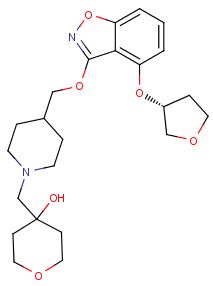 |
| Pfizer’s 5-HT4 partial agonist |
WO2011/101774 (Pfizer [US]; Aug. 25, 2011) is a patent application of a type that has become rare in pharmacology: a single compound, the serotonin 5-HT4 receptor partial agonist (R)-4-((4-((4-(tetrahydrofuran-3-yloxy)benzo[d]isoxazol-3-yloxy)methyl)piperidin-1-yl)methyl)tetrahydro-2 H-pyran-4-ol, is claimed for the treatment of neurodegenerative diseases, in particular Alzheimer’s. An impressive amount of chemical and synthesis information is provided.
A Laser-Activated Drug Delivery Device
WO2011/097634 (On Demand Therapeutics [US]; Aug. 11, 2011) presents an implantable drug delivery device that uses multiple reservoir elements to sequentially release doses when irradiated. Its outer shell consists of osmotically impermable material that can be easily destructed by laser radiation, exposing the inner shell which has low permeability for the drug it contains. Although laser radiation of appropriate sequences can penetrate several millimeters of living human peripheral tissue without being excessively absorbed, this invention is intended for the only organ where light absorption is not a problem at all – the eye. Intravitreal implants and laser treatments are extensively established therapeutic options for the posterior parts of the eye.