

Five exciting new patent documents (published February 2-16, 2012) are on the board today: gemifloxacin for neuroprotection; amlexalox for nonsense-mutation-mediated genetic diseases; alpha2a receptor blockers for liver cirrhosis; the established antihelminthic, moxidectin and the pain drug candidate radiprodil for neuropsychiatry.
H.M. Pharma Consultancy specializes in drug repurposing opportunities. (Find out more at www.hmpharmacon.comor contact us at office@hmpharmacon.com.) If you are a developer looking for such openings, we might be able to assist you. Of course, if one of the patent applications mentioned here claims an idea you had, it is already too late… But remember, with the data at your fingertips you will always find an angle with innovation. — Forward The Patentome!
A Fluoroquinolone for Neuroprotection
That tetracyclines have many pharmacological activities beyond their antibacterial actions is very well known, but this is not so for the class of fluoroquinolone antibiotics to which gemifloxacinbelongs. It is therefore highly significant that WO/2012/013850(Neuron Biopharma [ES]; Feb. 2, 2012) demonstrates its protective action in SK-N-MC human neuroblastoma cell cultures against the neurotoxic effects of tunicamycin, okadaic acid,3-nitropropionic acid, and camptothecin. Also, gemifloxacin is an acetylcholinesterase inhibitor, effective at concentrations between 4 and 40 µM. The peer review literature offers no pointer to any of these findings. PubMed has only one paper (“Convulsant activity and pharmacokinetic–pharmacodynamic modeling of the electroencephalogram effect of gemifloxacin in rats,” J Pharm Sci 2010; 99:1535–47), retracted in February 2012, that pointed exactly in the opposite direction.
Mouth Ulcers, Allergy and Astma – And Now Genetic Diseases
The immunomodulatory chromenopyridine, amlexanoxis used topically for aphthous stomatitis, but also systemically for bronchial asthma and allergic rhinitis. Its mechanism involves antagonism of the angiogenic and mitogenic activity of acidic fibroblast growth factor (FGF1) via blockade of its binding to the S100A13 protein. WO/2008/021210discloses it as an antagonist at histamine H1 and leukotriene receptors; others mention cancer. But now, WO/2012/016930(INSERM et al. [FR]; February 9, 2012) says that amlexanox is able to inhibit nonsense-mediated mRNA decay and/or has a read-through effect that enables functional protein synthesis from damaged genes that contain a premature stop codon. This is supported, inter alia, by data obtained with the dystrophin gene in cells from a patient suffering from Duchenne muscular dystrophy, a nonsense-mutation-mediated disease; 5 µM amlexanox was the most efficient concentration in this ex vivo system.
Alpha2a Adrenoceptor Antagonists for Cirrhosis
In liver cirrhosis increased sympathetic tone acts to compensate for reduced blood pressure, whereupon the systemic circulation becomes dependent upon this upregulation. Antagonizing adrenoceptors would be expected to result in further vasodilation and blood pressure reduction. WO/2012/020235(UCL Business [GB]; Feb. 16, 2012) shows that actually the opposite is true: In bile duct ligated rats the α2a antagonist BRL 44408 (10 mg/kg sc) significantly improved systemic hemodynamics and cardiac output, and reduced portal pressure (11.4 ± 3.4 vs. 18.0 ± 3.7 mmHg, p = 0.001), while hepatic blood flow increased; NFκB protein expression in the liver tissue was reduced. It appears from the data that the induced cirrhotic condition induced hepatic α2a expression in rats, which was absent in sham-operated controls. Note that BRL 44408, claimed as a treatment for inflammation in sepsis (see WO/2006/124770), also has antidepressant and analgesic activity (see here), which might be of additional benefit in cirrhosis patients. Of all pharmaceutical effects that α2a blockers are being investigated for, this is the most unusual and paradoxical one.
Moxidectin:From Worms to Neuropsychiatry
The target site of several antihelminthic compounds (e.g. levamisole, tetrahydropyrimidines) in nematodes is a family of pharmacologically distinct nicotinic acetylcholine receptor channels. Others, such as the avermectins and milbemycins, are believed to act through GABA-gated chloride channels. But now, WO/2012/020258(Conformetrix [GB]; Febr. 16, 2012) shows, by using patch-clamp electrophysiology on transgenic Xenopus oocytes, that milbemycin derivatives such as moxidectinare particularly potent positive allosteric modulators of the humanalpha-7 nicotinic acetylcholine receptor. This is the receptor involved in beta-amyloid toxicity, drug addiction, anxiety and depression, and pain; and the effect is much stronger than with related antihelminthics such as ivermectin or nemadectin. – A decade ago Bayer attempted repurposing of another antihelminthic drug, the cholinesterase inhibitor metrifonate, for Alzheimer’s disease.
A Troubled Analgesic Drug Candidate for ADHD, OCD and Autism
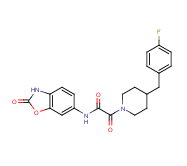 |
| Radiprodil |
In 2010 radiprodil(RGH-896), a selective and orally bioavailable NMDA NR2B antagonist, failed to produce significant pain score reductions in a Phase II trial for diabetic neuropathy, a classical field for NMDA receptor blockers. In WO/2012/020270(Gedeon Richer [HU]; Febr. 16, 2012) another angle is tried: attention deficit hyperactivity disorder, autism, Tourette’s syndrome, and obsessive-compulsive disorders — also known applications for this class of drugs, and therefore this is a classical “on-target / second use” patent application: perhaps not extremely innovative, but it could probably work and offer a new perspective for radiprodil. The data for ADHD, from male Harlan- Wistar rats receiving 6-hydroxydopamine (6-OHDA) in both lateral brain ventricles and tested in an object recognition paradigm, showed a highly significant improvement, comparable to the approved Eli Lilly ADHD drug atomoxetine (Strattera).