

Patents have gained bad publicity once again, mainly in the context of high-tech companies employing them to keep each other’s mobile computing innovations off the market as long as possible, or just to force cross-licensing deals. The press seems to take a natural delight in reporting on these infringement lawsuits, counter-suits, and whatnots. The background to these struggles — the material implementation of ideas — can be extremely technical, often making the actual height of innovation underlying these patents difficult to discern for the outsider.
Absurd as such struggles may seem, they are still rooted in innovation, however incremental that invention might be. This is probably unavoidable in an extremely dynamic consumer-oriented industry where even the most marginal edge over your competition can mean immediate commercial benefit — until the competition (again, incrementally) out-innovates you, which is likely to happen within months not years.
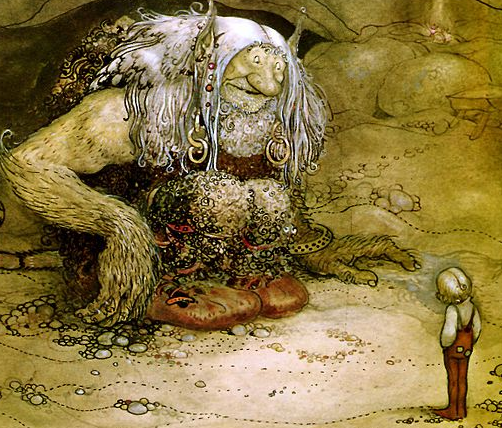 |
| From “The boy who never was afraid”, thanks to Wikimedia |
Predation implies selection, and that should be a good thing if (admittedly, a quite large if) selection works broadly toward more innovation. But there is an entirely different breed of predators out there as well, abusers of the patent system who are purely destructive. These shadowy entities do not care a bit about innovation; they do not research or develop. These are the patent trolls who file and hold patents purely to exploit dysfunctionalities in the patent system, especially in the United States where patents are much too liberally granted (to U.S. entities at least).
It is rare that a company stands up against this malpractice, carries its case successfully, and is able to report had beat the troll, as can be seen in this excellent, must-see video presentation:
http://www.ted.com/talks/drew_curtis_how_i_beat_a_patent_troll.html.
http://www.ted.com/talks/drew_curtis_how_i_beat_a_patent_troll.html.
(Thanks to Griffith Hack‘s Mike Lloyd for the pointer. For a case just as ridiculous, see here.)
The Life Sciences are not as massively affected by patent trolls as the IT, media and social networking businesses. To give an example, not even the USPTO would have granted a patent covering the treatment of all diseases and disorders with receptor tyrosine kinase involvement with any type of kinase inhibitor — which would have been the approximate equivalent for the “news distribution by email” patent discussed in the video. The long regulatory process also reduces the immediate benefit that could be drawn from pharmaceutical patent trolling. But especially in protein engineering there are broad generic method patents in force that can be turned into severe obstacles for medical innovation. And there are still more than enough granted patents – most especially U.S. patents – in force that are not supported by biological or medical data.
If you, as a pharma company, are sued by a patent troll we would suggest following the advice given in the video mentioned above:
1) Don’t negotiate. Make it clear from the beginning that you are going to make your opponents pay a steep price for every inch of the way.
2) Get expert advice, from a specialist who knows both the science and the patent side of such cases. (And yes, H.M. Pharma Consultancy is such a specialist… as you might have expected us to say.) This can turn the strongarming tactic employed by the trolls against themselves once you have discovered the soft spot in their claims — which may require rather unconventional thinking. You might be able to save huge patent attorney fees this way.
Patent trolls create no value; they are a massive distraction from innovation and an economic burden from which only lawyers draw a profit. Lets nip them in the bud wherever they show their hand in the pharmaceutical industry.