

In the aftermath of a fire that occurred at the WIPO offices on October 27, the patent documents that had been due on this day were not entered into the public WIPO database until early November. We will cover any remarkable life science documents that were to to be published in this batch in out next monthly review. – Even for the October 6-20 period we can present a selection of 9 PCT publications from the U.S., UK, Spain and France that stand out from the crowd. At least three – tetrathiomolybdate for hypothermia induction, valproate as an antiviral, and simvastatin for drug addiction – directly concern drug repurposing. Others discuss methionine aminopeptidase inhibitors for weight reduction; gamma-D-glutamyl-L-tryptophan for radiation-induced mucositis; engineered antibody constructs for Chikungunya virus infection; beta-2 microglobulin for autoimmune diseases; small molecules for spinal muscular atrophy, an orphan disease; and dopaminergic neurons from human plripotent stem cells to treat Parkinson’s disease.
PLEASE CITE AS: Mucke HAM. Patent Highlights for October 2011. Published online on the H.M. Pharma Consultancy Blog (URL:http://hmpharmacon.blogspot.com/2011/10/patent-highlights-for-october-2011.html) on October 28, 2011. Contact us at office@hmpharmacon.com.
—
A Copper Chelator Repurposed for Hypothermia Induction
Tetrathiomolybdate has one established therapeutic use (in Wilson’s disease) and several proposed ones, all of which are based on its ability to scavenge copper. WO 2011/121354 (Magnus Intellectual Property [UK]; Oct. 6, 2011) discloses a new application: reducing the body core temperature, a standard intervention in emergencies involving severe shock (e.g., from hypoxemia, haemorrhage or infection), trauma (brain injury), or potential post-ischemic reperfusion injury (including elective vascular and cardiac surgery surgery involving interruption and re-institution of blood flow). Intravenous infusion of tetrathiomolybdate into awake rats at at 10 and 20 mg/kg reduced oxygen consumption and CO2 production without sedation; in anesthetized rats a fall in core temperature was induced. The hyperthermic response to endotoxin was abolished at 20 mg/kg — an effect that might be related to the abrogation of lipopolysaccharide-induced inflammatory responses by tetrathiomolybdate (see here). However, that would not readily explain why endotoxemic animals also developed hypothermia.
Valproic Acid Against Enveloped Viruses
Many applications other than those for seizure disorders have been reported for the antiepileptic valproate, but WO 2011/121162 (CSIC [SP]; Oct. 6, 2011) offers a surprising activity beyond neurology: antiviral action against flaviviruses, especially emerging mosquito-transmitted viruses. Propagation of the neurotrophic West Nile virus strain NY-99, and also of Usutu virus, in Vero cells was inhibited at 50 mM. In infected mice, mortality rates were reduced from 75% to 17-25% by i.p. injection. The document does not speculate on the mechanisms involved.
Protein Processing Inhibitors for Obesity
The methionine aminopeptidases (MetAP1 and 2) are required for mammalian cell proliferation (review). MetAP2 is involved in the regulation of post-translational processing (by cleaving the N-terminal methionine residue of newly synthesized proteins) and protein synthesis (by protecting the subunit of eukaryotic initiation factor-2 from phosphorylation). Small molecule inhibitors such as the 3,5-bis(benzylidene)-4-piperidone derivative NC2213 have been proposed as treatments for cancers which overexpress the enzyme. WO 2011/127304 Zafgen [US]; Oct. 13, 2011) claims irreversible MetAP2 inhibitors, e.g. fumaligin derivatives, for — weight reduction in obesity, at doses that do not substantially modulate angiogenesis. Based on data from mice (1 mg/kg daily for 250 days while on a high-fat diet), the inventors believe that fat oxidation and lipolysis are stimulated by enhancing the level and function of thioredoxin and/or overriding the inhibitory effects of hyperinsulinemia and/or of high fat diet induced NADPH oxidase activity.
An Unnatural Dipeptide to Prevent Mucositis
In many cancer therapies, especially those that involve radiation, oral mucositis is a dose-limiting side effect that severely interferes with quality of life. Most preventive measures merely attempt to coat and stabilize the buccal mucosa with gel films. Gamma-D-glutamyl-L-tryptophan (SCV-07) stands out because it is a complex immune modulator. Response is not complete but can be predicted on the basis of gene signatures (see here). WO 2011/126853 (SciClone [US]; Oct. 13, 2011) is an omnibus document that summarizes the preclinical development of SCV-07 and a Phase II study in head and neck cancer patients — so far perhaps the best review on this interesting molecule from Russia which had originally been investigated for the treatment of tuberculosis (see here).
Antibody Constructs for Chikungunya Infection
There is no vaccine and no specific treatment available for Chikungunya fever, an epidemic disease caused by an arbovirus transmitted by Aedes mosquitoes. In WO 2011/124635 (Humalys [FR]; October 13, 2011), antibody engineering has been set to work on two original mAbs (8B10F8 and 5F10F175E2) to create neutralizing recombinant protein constructs (rec8B10F8 and rec5F10F175E2) that bind to the E1 or E2 surface glycoproteins of Chikungunya virus A226 and A226V strains with picomolar Kd values. The constructs are Fv fragments, the minimum dimer of one heavy- and one light-chain variable domain that constitutes a complete antigen-recognition and -binding site. Obviously, the entire battery of today’s protein engineering technologies (reviewed e.g. in our recent report) can be set loose to modify these basic constructs and to adapt them to desired criteria. Gene sequences and extensive in vitro and cell culture data are provided.
Beta2 Microglubulin as an Immunomodulatory Drug
WO 2011/125029 (Beta Innov [FR]; Oct. 13, 2011) presents the ubiquitous serum and cerebrospoinal fluid protein beta2-microglobulin (β2m) as an active ingredient for the treatment of autoimmune diseases. This is less surprising than it might seem at first sight: β2m is a constituent of the Class I major histocompatibility complex; knockout mice do not develop CD8 lymphocytes and have correspondingly impaired immune responses. The 99 aminoacid protein – which is not glycosylated and hardly immunugenic by itself – has actually been used as a vaccine adjuvant. The inventors have found decreased relative concentrations of β2m (compared to healthy controls) with respect to MHC I heavy chain proteins in four patients suffering from Hashimoto’s thyroiditis with primary Sjogren’s syndrome and/or celiac disease, or multiple sclerosis. They believe that this is cause, not effect, and that restoration of the molar ratio (calculated on the basis of the total lymphocyte protein) to values below 2 and approaching 1 (the ratio seen in controls) should be therapeutic. Administration of β2m-loaded cholesterol/sphingomyelin liposomes is proposed (and extensive data on such liposomes are presented), as is gene therapy.
New Hope for Spinal Muscular Atrophy
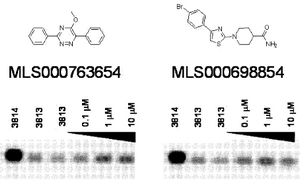
Substituted thiazol-2-yl-piperidines and -piperazines increase production of SMN2, the isoform of survival motor neuron protein that is expressed from a centromeric copy, and this should improve disease serverity in spinal muscular atrophy: this is the message from WO 2011/130515 (U.S. Dept. of Health and Univ. of Massachusetts [US]; Oct. 20, 2011). Molecules featuring desirable potency below 150 nM in a luciferase reporter assay were examined to evaluate the effect on the human SMN protein expression using fibroblasts from SMA patients. A compound identified as 8m (not readily identifiable among the many specifically claimed molecules) at 37 nM increased the SMN protein level by 2-3 fold, and produced a more than 2 fold of increase of the number of SMN positive foci in the nucleus. The SMN protein level decreased with increasing drug concentration, matching the bell-shaped curve observed in the reporter assay. Two other compounds (see figure) were also investigated in great detail.
Human Dopaminergic Neurons From Pluripotent Stem Cells
Many years ago the first trials with human fetal mesencephalic tissue implants in patients suffering from Parkinson’s disease stirred up a huge ethical row. Much has been learned since then and attempts to generate dopaminergic replacement neurons from stem cells of various sources have become a hot field of neurodegeneration research (see this review). WO 2011/130675 (McLean Hospital [US]; Oct. 20, 2011) claims methods to differentiate dopaminergic SN-A9 substantia nigra neurons or ventral tegmental area (VTA-A10) neurons not only from human embryonic stem cells but also from induced pluripotent stem cells, which are ethically uncritical and could be patient-isogenic to reduce the risk of immune rejection. This is achieved by exposing the stem cells to retinoic acid, human sonic hedgehog (SHH) protein, and FGF8A protein, optionally also with a WNT1 protein, in an inert biological suspension matrix and artificial cerebrospinal fluid. Although isolated non-neural cell types may remain in these cultures, purified populations of SN-A9/VTA-A10 neurons are obtained using flow cytometry. – This patent application, which documents research partially funded by the Udall Parkinson’s Disease Center of Excellence, contains an impressive amount of in vitro data.
An (n+1)th Use for Statins
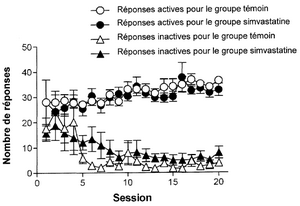
If you believe that you know all about the many activities of statins that have been reported beyond inhibition of 3-hydroxy-3-methyl-glutaryl-CoA reductase inhibition (the activity responsible for serum cholesterol reduction), look here: WO 2011/128810 (CNRS [FR]; Oct. 20, 2011) tells us that chronic administration of simvastatin (1 mg/kg i.p.) to cocaine-dependent rats reduced cocaine self-administration and the craving reaction precipitated by withdrawal. There was a comparable effect in a model of nicotine dependence. The peer review literature holds very little (if anything) on this subject; lovastatin did not influence cocaine clearance from serum (see here), but in 1998 Chongquing Medical University had claimed a lovastatin transdermal system for smoking cessation in CN 1186659.